

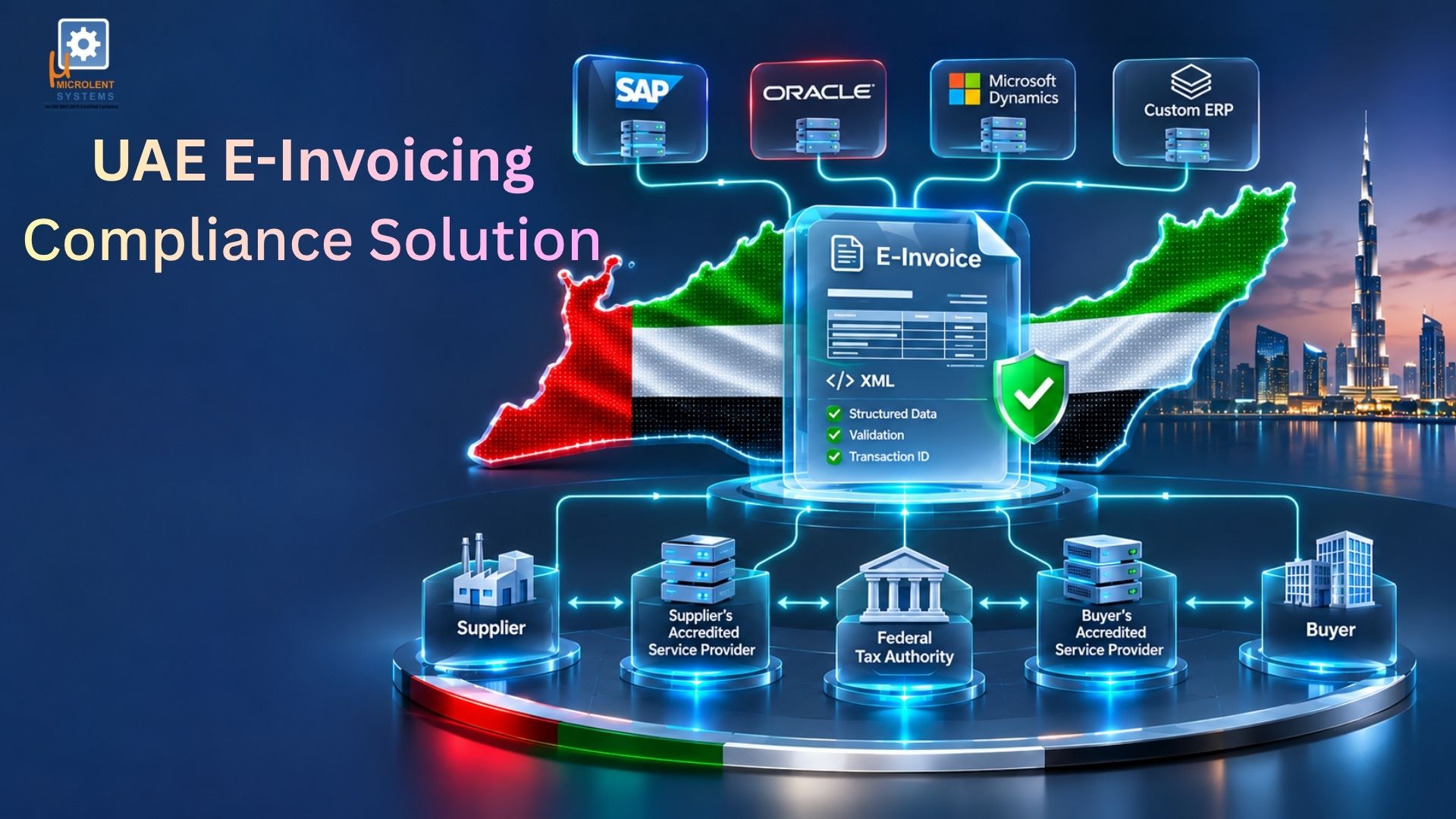

Is Your ERP System Ready for UAE E-Invoicing?Prepare your business systems for UAE e-invoicing with the right integration architecture and technical support from Microlent.
|
What Does UAE E-Invoicing Compliance Require?
UAE e-invoicing requires businesses within the regulatory scope to issue, receive, exchange, and report structured electronic invoices through an approved service provider. Unlike PDF invoices, these transactions use standardised machine-readable data formats, enabling automated validation, exchange, and tax reporting across business systems.
The framework applies to relevant Business-to-Business (B2B) and Business-to-Government (B2G)
transactions, subject to specified exclusions.
For finance and technology teams, preparation
involves more than replacing paper invoices. Businesses must assess:
-
Existing accounting and ERP infrastructure.
Customer and supplier master data.
- Tax information and mandatory invoice fields.
- Integration requirements with an ASP.
- Invoice validation and exception-handling workflows.
- Electronic invoice storage and audit requirements.
Under amended Article 6(5), and subject to Article 6(4), the Issuer must issue and transmit an Electronic Invoice or Electronic Credit Note through the Electronic Invoicing System within 14 Business Days from the Date of Business Transaction.
The Accredited Service Provider UAE framework establishes the authorised service provider ecosystem
through which businesses exchange electronic invoices and fulfil reporting requirements.
Which UAE Businesses Must Comply and By When?
The UAE has introduced phased e-invoicing implementation based on annual revenue and entity
classification. Businesses with annual revenue of AED 50 million or more fall under Phase 1, while
businesses below this threshold generally fall under Phase 2, subject to the applicable scope and
exclusions.
What Are the UAE E-Invoicing Implementation Dates?
The UAE rollout uses different appointment and go-live dates for businesses based on annual revenue, while government entities follow a separate schedule. The table below summarises the published phases; businesses should confirm their classification and check the latest Ministry of Finance guidance before acting on a deadline.
|
Business Category |
Annual Revenue |
ASP Appointment Deadline |
Mandatory Implementation |
|---|---|---|---|
| Phase 1 Businesses | AED 50 million or more | 30 October 2026 | 1 January 2027 |
| Phase 2 Businesses | Below AED 50 million | 31 March 2027 | 1 July 2027 |
| Government Entities | As applicable | 31 March 2027 | 1 October 2027 |
As of 17 November 2026, the Phase 1 ASP appointment deadline has passed. Businesses in this phase should
confirm their ASP onboarding status and continue preparing for mandatory implementation on 1 January
2027.
What Should Businesses Prepare Before Their Deadline?
Before the deadline, finance and IT teams should check transaction scope, source data, ERP connectivity,
and internal ownership. Reviewing these areas early helps identify missing tax fields, supplier data
gaps, API constraints, and testing needs before the business begins exchanging electronic invoices
through its appointed ASP.
- Finance readiness: Review VAT records, invoice data, and customer and supplier information.
- Technical readiness: Assess ERP compatibility, integration architecture, and invoice data mapping.
-
Operational readiness: Establish validation, exception management, and reporting
procedures.
The applicable implementation date should be assessed against the business's regulatory classification
and relevant revenue records, rather than its general market description as a medium-sized or large
business.
How Does the UAE Peppol 5-Corner Model Work?
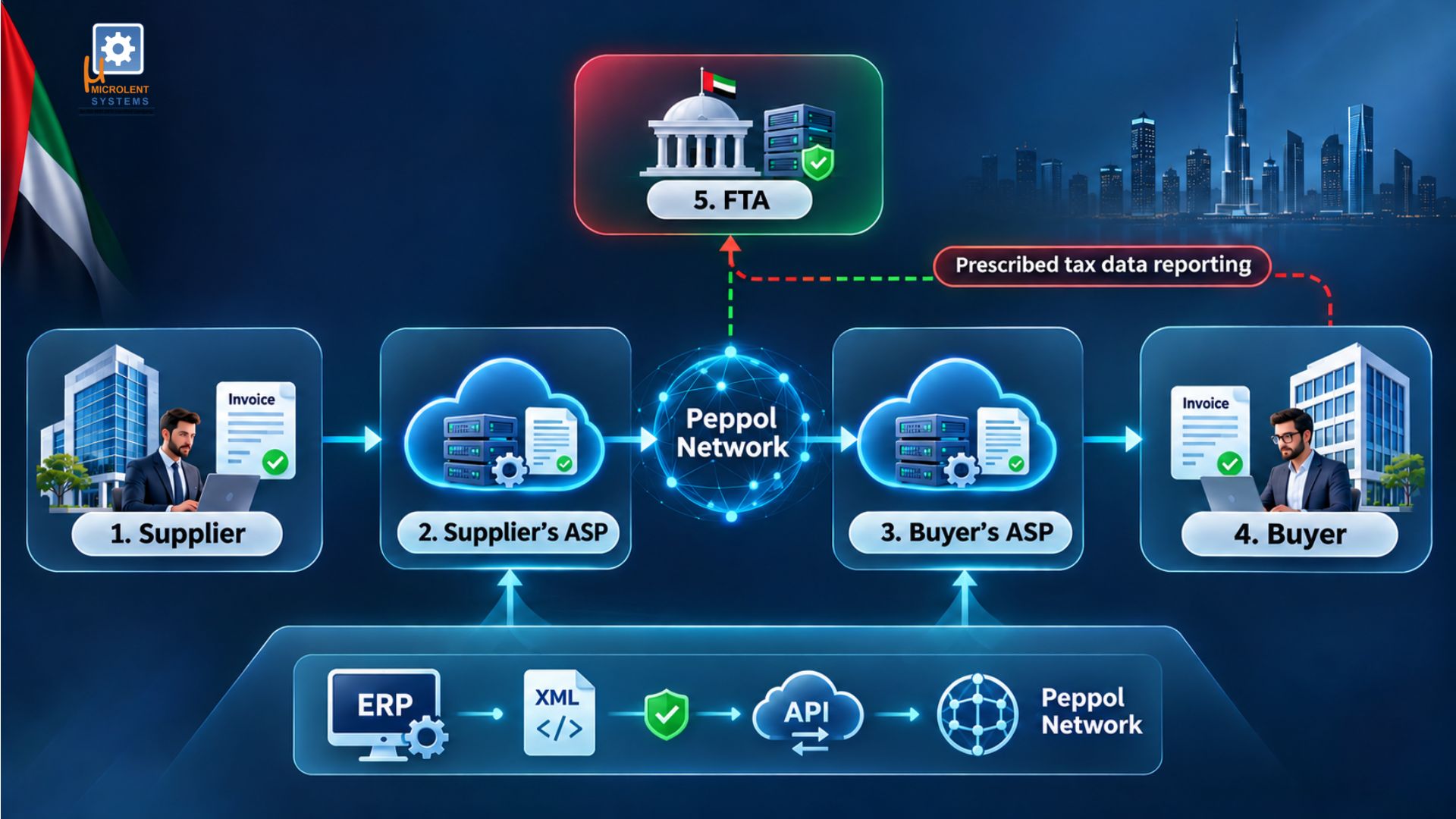
The UAE uses a decentralised five-corner e-invoicing model to exchange structured invoices between
suppliers and buyers through their respective ASPs, while prescribed tax data is reported to the FTA.
The model separates invoice exchange from tax-data reporting and assigns a distinct role to each
participant.
How Does Each Corner Participate in Invoice Exchange?
In the five-corner model, the supplier sends invoice data to its ASP, which exchanges it with the buyer's ASP. The buyer's ASP delivers the invoice to the buyer, while prescribed tax data is reported to the FTA as Corner 5.
|
Corner |
Participant |
Responsibility |
| Corner 1 | Supplier | Creates and submits the electronic invoice. |
| Corner 2 | Supplier's ASP | Validates and transmits invoice data. |
| Corner 3 | Buyer's ASP | Receives and processes the invoice. |
| Corner 4 | Buyer | Receives the electronic invoice. |
| Corner 5 | FTA | Receives reported tax data. |
Why Does Peppol PINT-AE Matter?
Peppol provides the network and interoperability framework, while PINT-AE defines the UAE-specific invoice data requirements. Businesses must map their ERP fields to the applicable data dictionary and generate structured XML
that can be validated and exchanged by their ASP, rather than treating a PDF as an e-invoice.
- Businesses must account for:
Structured invoice data and mandatory fields. - PINT-AE data specifications.
- UBL-based XML invoice structures.
- Business and tax validation rules.
- Electronic invoice exchange and reporting.
XML invoice generation must follow the applicable technical specifications rather than simply converting an existing PDF invoice into an XML file.
The service provider validates invoice data against the UAE requirements before exchanging the invoice through the Peppol network and reporting relevant tax information to the FTA.
How Can Existing ERP Systems Connect to an ASP?
Businesses using SAP, Oracle, Microsoft Dynamics, or custom ERP platforms can connect their existing
systems to an Accredited Service Provider through APIs, integration middleware, and structured data
transformation. This approach allows finance teams to retain established business workflows while
supporting compliant electronic invoice exchange.
What Does Enterprise ERP Integration Involve?
An ASP integration connects the ERP's invoice and master-data records to the appointed service provider,
usually through APIs, middleware, or supported connectors. The workflow should cover extraction, field
mapping, validation, transmission, status responses, and reconciliation so finance teams can trace each
invoice from creation through delivery.
- Data extraction: Retrieve invoice, customer, supplier, and tax information from the existing ERP.
- Data transformation: Map internal ERP fields to the required UAE invoice data structure.
- Validation: Check mandatory fields, tax calculations, and business rules.
- Invoice transmission: Send structured invoice data to the selected ASP.
- Response handling: Process acknowledgements, validation errors, and invoice status updates.
-
Reporting and reconciliation: Maintain transaction records and reconcile invoice
processing outcomes.
What Should Businesses Check Before ERP Integration?
ERP integration depends on the product edition, deployment model, existing customisations, API
availability, and the ASP's supported interfaces. Before selecting an approach, IT teams should confirm
how invoice fields, tax codes, entity identifiers, attachments, acknowledgements, and error messages
will move between the ERP and the service provider.
|
ERP Platform |
Integration Considerations |
| SAP S/4HANA | Invoice data mapping, APIs, tax configuration, and enterprise workflows. |
| Oracle NetSuite | Transaction data extraction, integration APIs, and invoice transformation. |
| Microsoft Dynamics 365 | Finance data mapping, connectors, and automated processing. |
| Custom ERP | API development, middleware, database integration, and XML transformation. |
Effective UAE ERP integration requires coordination between finance, tax, IT, and external service providers. Businesses managing finance, procurement, inventory, and customer information across different applications can use ERP and CRM systems to centralise operational data and establish connected business workflows.
For businesses managing multiple subsidiaries, the integration architecture should also account for entity-specific tax information, transaction ownership, invoice numbering, and centralised reporting requirements.
From 1 January 2027, Ministerial Decision No. 197 of 2026
excludes business transactions between members of the same Tax Group from the UAE e-invoicing
requirements for 24 months. However, this temporary exclusion applies to qualifying transactions between
group members, not all transactions conducted by those businesses. Each member of a VAT Tax Group must
still have an endpoint through a UAE Accredited Service Provider, as confirmed by the FTA.
When Does Custom ERP Middleware Make Sense?
Custom middleware is useful when standard e-invoicing applications cannot adequately support existing
enterprise workflows, multiple ERP platforms, or complex financial data structures. It provides an
integration layer between internal business applications and an accredited service provider without
requiring every ERP system to be replaced. A well-planned software architecture
helps define the system structure, integration strategy, security requirements, and scalability before
development begins.
How Do Standard E-Invoicing Tools Compare With Custom Middleware?
Off-the-shelf tools can suit businesses with standard processes and supported ERP connections, while custom middleware may fit organisations with legacy systems, multiple ERPs, or specialised workflows. The right choice depends on integration complexity, internal support capacity, data controls, and the cost of maintaining each approach.
|
Evaluation Area |
Off-the-Shelf Tools |
Custom Enterprise Middleware |
| Deployment | Standard implementation | Architecture-specific implementation |
| ERP Connectivity | Supported connectors | Custom API and legacy integration |
| Data Transformation | Predefined mapping | Configurable transformation rules |
| Multiple ERP Systems | Depends on product capabilities | Can support multiple ERP environments |
| Multi-Entity Operations | Depends on platform | Customised entity-level workflows |
| Business Processes | Standard workflows | Adaptable enterprise workflows |
| Scalability | Product-dependent | Designed around integration requirements |
Where Can Microlent Support Enterprise Integration?
Microlent's enterprise software portfolio includes custom web, mobile, and ERP-related applications, with DuctArchitect as an example of an industry-specific ERP platform. For a UAE e-invoicing project, the scope should be defined around system boundaries, invoice data sources, ASP interfaces, and the responsibilities of each technology partner.
For organisations evaluating Custom e-invoicing software, the focus should be on designing an
integration architecture that connects existing applications with the selected ASP. Microlent's custom software development services
support business-specific workflows, legacy system modernisation, and third-party platform
integration.
Microlent's E-invoicing software development capabilities can be positioned around:
- Custom API and middleware development.
- Legacy ERP connectivity.
- Structured XML and JSON data processing.
- Invoice data transformation.
- Multi-entity integration workflows.
- Automated validation and exception handling.
An E-Invoicing business solution should complement the organisation's existing financial infrastructure
rather than introduce unnecessary operational complexity.
What Penalties Apply to Non-Compliant Businesses?
UAE e-invoicing legislation sets administrative penalties for failures to meet applicable system obligations. Cabinet Decision No. 173 of 2026 lists penalties for implementation failures, missing electronic invoices or credit notes, and failure to notify an ASP of changes to registered information.
UAE administrative penalties cover failures to implement the system or appoint an ASP, failure to issue
and transmit electronic invoices or credit notes, and failure to notify an ASP of changes to registered
information. The applicable amount depends on the specific violation and the limits stated in the
decision.
What Are the UAE E-Invoicing Penalties?
The penalty schedule assigns different amounts to implementation failures, unissued or untransmitted
invoices, missing credit notes, and delays in updating ASP registration data. Charges include fixed,
per-document, and daily amounts, with monthly or rolling 12-month caps depending on the
violation.
|
Violation |
Administrative Penalty |
| Failure by the Issuer to issue and transmit an Electronic Invoice to the Recipient through the Electronic Invoicing System. | AED 100 for each Electronic Invoice, up to a maximum of AED 5,000 per calendar month. |
| Failure by the Issuer to issue and transmit an Electronic Credit Note to the Recipient through the Electronic Invoicing System. | AED 100 for each Electronic Credit Note, up to a maximum of AED 5,000 per calendar month. |
| Failure by the Issuer or Recipient to notify the appointed Accredited Service Provider of any changes to the data registered with the Authority. | AED 250 for each day of delay or part thereof, up to a maximum of AED 5,000 per calendar month. |
|
(a) Failure by the Issuer or Recipient to implement the Electronic Invoicing System in accordance with Ministerial Decision No. 244 of 2025 and its amendments, or any decision replacing it, including failure to appoint an Accredited Service Provider.
(b) Failure by the Recipient, after implementing the Electronic Invoicing System under paragraph (a), to maintain compliance with its obligations as a Recipient under Ministerial Decision No. 243 of 2025 and its amendments, or any decision replacing it. |
AED 5,000 for the first instance in which the Issuer or Recipient commits the violation under paragraph (a), paragraph (b), or both. An additional AED 5,000 applies for each month or part thereof during which non-compliance continues, subject to a maximum total penalty of AED 50,000 within any 12 consecutive months. |
Under Article 3(2) of the updated penalty framework, if the same Person acts as an Issuer, a Recipient, or both in relation to the same violation, only one administrative penalty applies to that Person for that violation.
Article 5 of the decision states that it takes effect on the day following its publication in the
Official Gazette. The publication date should be verified before stating when these penalties become
enforceable. Businesses should assess their regulatory obligations, maintain accurate invoice records,
and establish operational controls to reduce compliance risks.
How Can Businesses Reduce Implementation Risks?
UAE businesses can reduce e-invoicing implementation risks through early regulatory assessment, ERP
readiness checks, ASP coordination, and structured integration testing. A defined implementation
strategy helps finance and IT teams identify data gaps, validate invoice workflows, manage exceptions,
and maintain accurate electronic transaction records.
A structured compliance programme should include:
- Regulatory Assessment: Confirm scope and applicability.
- ERP Readiness: Review existing finance systems.
- ASP Coordination: Plan provider selection and onboarding.
- Data Validation: Map and verify invoice information.
- Integration Testing: Test workflows and exceptions.
-
Compliance Monitoring: Maintain records and reconciliation controls.
- Microlent can support organisations assessing their existing software infrastructure and planning custom ERP integration requirements for the UAE electronic invoicing framework.
FAQs
1. Which E-Invoicing Solution Should UAE Mid-Sized and Large Businesses Choose?
The right e-invoicing solution for UAE businesses should support Peppol PINT-AE specifications, accredited service provider connectivity, automated invoice validation, and existing ERP integration requirements. Mid-sized and large organisations should assess whether their current accounting infrastructure can exchange structured electronic invoices without disrupting financial operations. The UAE Ministry of Finance framework follows the Decentralised Continuous Transaction Control and Exchange (DCTCE) 5-corner model, requiring businesses to work through an Accredited Service Provider. Companies operating SAP S/4HANA, Oracle NetSuite, or Microsoft Dynamics 365 should evaluate API compatibility, data transformation, and multi-entity processing when connecting their existing platforms with ERP and CRM systems. A suitable UAE E-Invoicing Compliance Solution should address regulatory requirements alongside the organisation's existing finance and technology architecture.
2. Which Technology Companies Can Help UAE Businesses Implement E-Invoicing?
UAE businesses can engage accredited service providers for regulated invoice exchange and technology development companies for ERP integration, middleware, and customised financial workflows. These are different responsibilities and should be evaluated separately. The Ministry of Finance publishes the official register of accredited providers, which businesses should consult before selecting their service provider. Technology partners can help connect SAP, Oracle NetSuite, Microsoft Dynamics 365, and custom enterprise applications with the selected provider. Microlent offers custom software engineering, API development, and enterprise application capabilities, supported by its project portfolio and DuctArchitect ERP platform. Businesses in Dubai and Abu Dhabi should assess technical experience, integration scope, data security, and implementation responsibilities before appointing a technology partner.
3. What Are the UAE E-Invoicing Requirements for Businesses Operating in Dubai and Abu Dhabi?
UAE e-invoicing requirements include structured electronic invoice exchange for in-scope business transactions, use of an accredited service provider, and compliance with the UAE data dictionary and applicable implementation dates. The rules cover B2B and B2G transactions, regardless of whether the parties are registered for VAT. The Peppol PINT-AE specification defines the UAE invoice structure, while the service provider validates invoice fields before exchange and reports the prescribed tax data to the FTA. Businesses in Dubai and Abu Dhabi should review their transaction types, entity status, revenue band, customer and supplier records, and invoice workflows. Consumer sales to individuals acting outside a business are not themselves in-scope e-invoicing transactions. Scope also depends on statutory exclusions and the role each entity plays in a transaction.
4. How Does the UAE FTA Receive and Validate Electronic Invoice Information?
Under the UAE's decentralised five-corner model, the supplier's ASP validates invoice data and exchanges the invoice with the buyer's ASP, while prescribed tax data is reported to the FTA. The supplier submits structured invoice data to its ASP (Corner 2), which checks the fields against the UAE data dictionary before transmitting the invoice through Peppol to the buyer's ASP (Corner 3). The buyer's ASP validates the incoming invoice and delivers it to the buyer. Tax data is reported to Corner 5, the FTA, and message-level status responses are returned through the network. Peppol AS4 and its public key infrastructure support secure message transmission between access points. EmaraTax supports taxpayer and ASP onboarding; it is not the invoice exchange network.
5. Can Existing SAP, Oracle, and Microsoft Dynamics Systems Support UAE E-Invoicing?
Yes. Existing SAP, Oracle, and Microsoft Dynamics environments can connect to the UAE e-invoicing framework through APIs, middleware, or provider-supported connectors, subject to each system's configuration and the chosen ASP interface. An integration layer can extract invoice, customer, supplier, and tax data, map it to the UAE's PINT-AE requirements, and send it for validation and exchange. SAP S/4HANA, Oracle NetSuite, and Microsoft Dynamics 365 deployments may differ in available APIs, modules, customisations, and licensing, so the technical design must be checked against the actual environment. The selected ASP should confirm supported interfaces, message formats, testing steps, and error-response handling before go-live. ERP replacement is not automatically required. Integration testing should include authentication and access controls.
6. What Is the Difference Between an Accredited Service Provider and Custom ERP Middleware?
An Accredited Service Provider handles regulated electronic invoice exchange, while custom ERP middleware connects internal business applications with the provider's technical infrastructure. An ASP receives, validates, transmits, and reports invoice information according to UAE requirements. Middleware manages internal data extraction, transformation, application connectivity, and workflow automation. The two components serve different purposes and can operate together within one enterprise architecture. For example, an organisation using SAP S/4HANA may use middleware to transform its financial records into the required PINT-AE structure before transmitting them through its selected ASP. Businesses should verify the provider's current Ministry of Finance accreditation independently rather than assuming that a software integration partner holds the same status.
7. Does a UAE Business Need an Accredited Provider for Both Sending and Receiving Invoices?
Each UAE business entity within scope must appoint one ASP for both sending and receiving electronic invoices; it should not use separate providers for accounts receivable and accounts payable. The FTA's guidance ties the Peppol Participant Identifier to the entity's TIN. Each VAT Tax Group member has its own TIN and must have an endpoint through a UAE ASP; the endpoint details should identify the member conducting the transaction. The temporary exclusion for certain transactions between members of the same Tax Group does not remove the onboarding requirement. Finance and IT teams should map each legal entity, TIN, endpoint, and provider relationship before configuring ERP workflows. The selected ASP should be recorded for each entity during implementation.
8. Does a UAE Company Need E-Invoicing If It Only Makes B2C Sales?
Yes, a UAE business that makes only B2C sales may still have to appoint an ASP and implement e-invoicing if it receives goods or services from other businesses in the course of its business. The FTA explains that scope depends on business transactions, not only on the type of sales a company makes. In this situation, the company's consumer-facing sales are not themselves B2B e-invoices, but its in-scope business purchases can create recipient-side obligations. The company should review supplier transactions, statutory exclusions, its revenue band, and its implementation phase. This distinction matters for retailers, hospitality groups, and service businesses in Dubai and Abu Dhabi that sell to consumers but buy from business suppliers. Review both buyer and seller workflows.
9. What Happens If a Business Misses Its UAE E-Invoicing Implementation Deadline?
Businesses that fail to meet applicable UAE electronic invoicing obligations may face administrative penalties under the relevant legislation and its effective dates. Cabinet Decision No. 173 of 2026 establishes penalties for implementation failures, invoice transmission failures, and delays in notifying an ASP about changes to registered information. The decision specifies AED 5,000 for an initial implementation violation, followed by AED 5,000 for each month or part thereof that non-compliance continues, subject to a maximum of AED 50,000 in any consecutive 12-month period. Separate penalties apply to missing invoices and credit notes. Businesses should verify the decision's effective date in the Official Gazette before assessing which penalty provisions apply.
10. How Should Multinational Businesses Prepare Their ERP Infrastructure for UAE E-Invoicing?
Multinational businesses should prepare by mapping each UAE legal entity, its TIN, invoice flows, ERP platform, and ASP onboarding requirements before changing production systems. The DCTCE 5-corner model and PINT-AE specifications set the exchange and data requirements, while the ERP integration design must reflect each entity's records and controls. Groups using SAP S/4HANA, Oracle NetSuite, Microsoft Dynamics 365, or local applications should document data ownership, invoice numbering, tax codes, API access, exception handling, and reconciliation responsibilities. For Tax Groups, the MoF Guidelines state that each member has its own TIN and must be onboarded, while certain intra-group transactions are temporarily excluded for 24 months from 1 January 2027. A UAE E-Invoicing Compliance Solution should account for these entity-level requirements, and representative workflows should be tested before deployment.