
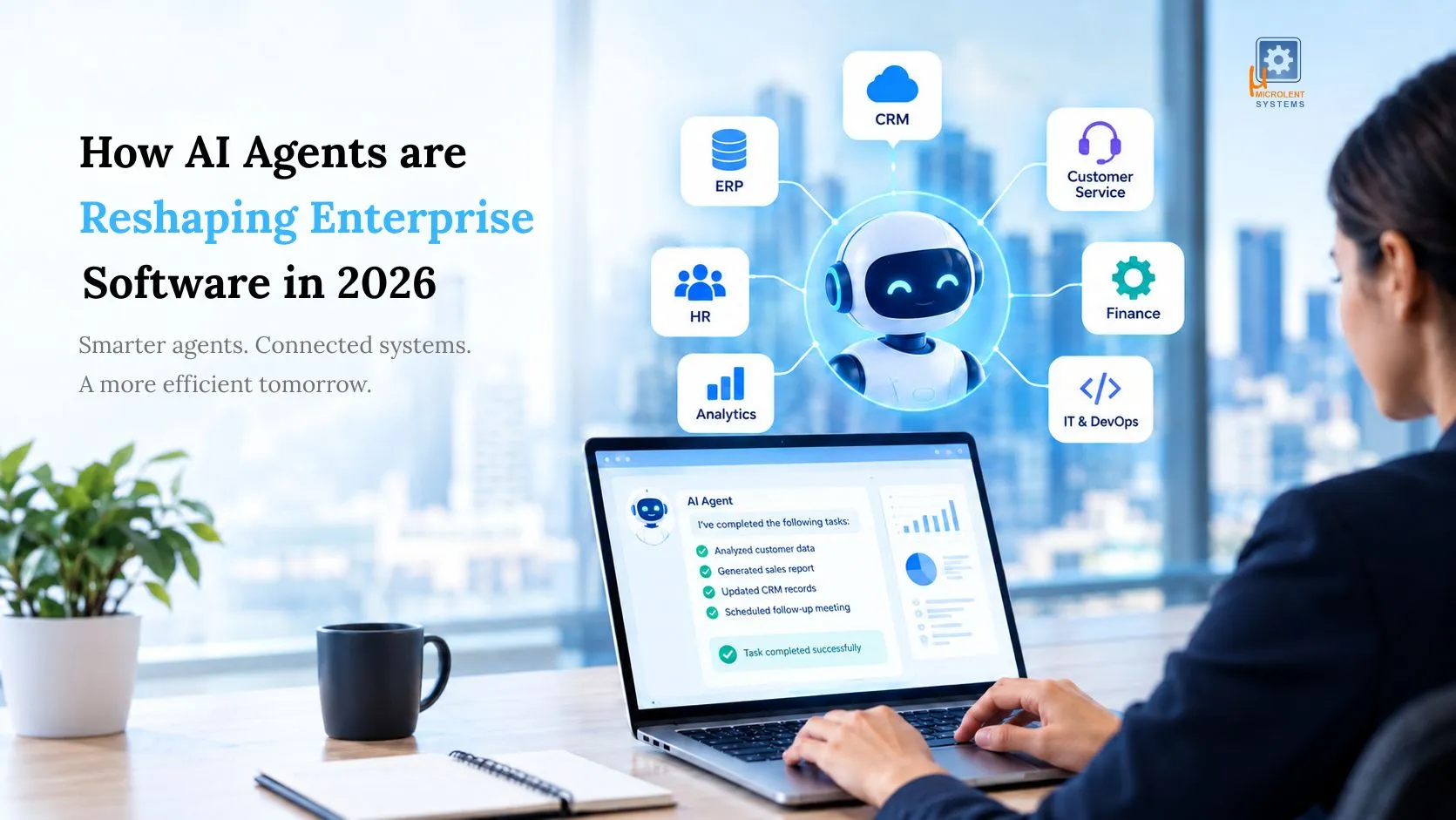
Enterprise software is moving from systems that help employees perform tasks to systems that can increasingly perform tasks on their behalf. In 2026, AI agents are becoming part of CRM, ERP, HR, finance, customer service, software development, analytics, and other enterprise workflows.
Unlike traditional AI assistants that mainly answer questions or generate content, AI agents can understand goals, use business data, interact with software tools, complete multiple steps, and return results with limited human intervention.
This shift is changing not only enterprise applications but also how organizations design workflows, manage employees, and make technology decisions.
What Are AI Agents in Enterprise Software?
AI agents in enterprise software are software-based systems that can understand a business objective, plan a sequence of actions, use connected tools or applications, and complete tasks under defined permissions.
For example, a traditional CRM might show a salesperson which leads require attention. An AI agent could analyze the leads, identify high-priority prospects, prepare personalized follow-up messages, update CRM records, and schedule follow-ups according to company rules.
The important change is the move from information to execution.
OpenAI's 2026 enterprise research describes this transition as a movement from AI assistance toward delegated work, where agents receive business context and tools to complete more substantial tasks.
|
Explore AI & Chatbot Solutions Discover how AI agents and custom chatbots can streamline business processes, improve customer experiences, and drive smarter automation. Let’s discuss your requirements on WhatsApp. |
How Are Enterprises Building AI Agents in 2026?
Enterprises are generally not building one giant AI system to control every business process. Instead, they are creating specialized agents for specific workflows and connecting them to existing enterprise systems.
A typical approach includes five layers:
1. Identify a Specific Business Workflow
Companies first identify processes where employees spend significant time gathering information, making routine decisions, or moving data between applications.
Examples include:
- Customer support ticket handling
- Sales lead qualification
- Invoice processing
- Employee onboarding
- Financial reporting
- IT support
- Software testing
- Document analysis
- Procurement workflows
Starting with a defined workflow makes it easier to measure whether an AI agent is actually delivering value.
2. Connect Agents to Enterprise Data
An AI model alone does not understand a company's internal processes.
Enterprises therefore connect agents to sources such as CRM systems, ERP platforms, databases, document repositories, knowledge bases, APIs, and internal applications.
This is where AI agent integration becomes important. The agent needs controlled access to the right information and tools instead of simply generating generic responses.
3. Give Agents Tools and Permissions
Modern agents can use tools to perform actions rather than simply produce text.
For example, an HR agent might:
- Read an employee request.
- Check company policy.
- Retrieve employee information.
- Create an HR ticket.
- Notify the appropriate team.
- Record the action.
Permissions and approval controls are essential because an agent that can take action creates a different risk profile from a chatbot that only answers questions.
4. Add Human Oversight
Enterprise AI does not necessarily mean completely autonomous software.
Many organizations are adopting a model where AI handles execution while people supervise important decisions, approve sensitive actions, and manage exceptions. Capgemini describes this shift as moving people from direct execution toward supervision, approval, and exception handling.
5. Monitor and Improve Agents
AI agents need continuous monitoring.
Enterprises need to evaluate:
- Accuracy
- Cost
- Response time
- Security
- Policy compliance
- Human intervention
- Successful task completion
- Errors and exceptions
This makes observability and governance an important part of enterprise AI architecture.
AI's Next Operating Model
The biggest change may not be the AI model itself. It may be how businesses organize work around AI.
Traditional enterprise software is usually application-centric. Employees open an ERP, CRM, HR platform, or analytics tool and perform tasks inside that application.
The emerging model is increasingly intent-centric.
Instead of navigating several applications, an employee may state an objective such as:
"Prepare the monthly sales report and identify accounts that require immediate attention."
An AI agent can potentially gather information from multiple systems, analyze it, create the report, and highlight exceptions.
There are AI-driven operating model in which humans and AI agents work together through agentic tools and workflows.
The result is a shift from software as a destination toward software as an intelligent layer that executes business processes.
Types of AI Users in the Enterprise
As AI becomes embedded into enterprise software, employees will not all use AI in the same way. Several types of AI users are emerging.
AI-Assisted Users
These employees use AI primarily for tasks such as writing, summarization, research, analysis, and brainstorming.
AI-Delegating Users
These users give AI agents larger assignments and allow them to complete multiple steps independently.
AI-Supervising Users
These employees focus on reviewing agent activity, approving decisions, handling exceptions, and ensuring that AI follows organizational policies.
AI-Orchestrating Users
These users design or manage multiple agents and workflows. They may determine which agent handles a particular task and how different systems exchange information.
What Are the Key AI Trends for Enterprises in 2026?
Several trends are shaping enterprise AI this year.
1. Agentic AI Moves Beyond Experiments
Enterprises are moving from isolated AI pilots toward AI agents embedded in real workflows. IDC reported in June 2026 that 50% of organizations surveyed were already deploying AI agents in production across multiple business areas.
2. AI Agent Integration Becomes a Core Requirement
Connecting AI with CRM, ERP, HR, finance, customer service, and internal databases is becoming more important than simply selecting a powerful AI model.
3. Business Data Becomes a Competitive Asset
AI agents need accurate organizational context. Companies are therefore paying greater attention to data quality, permissions, metadata, knowledge management, and business-specific information.
4. AI Governance Becomes More Important
More autonomous systems require stronger identity, access control, audit trails, monitoring, and approval mechanisms. Deloitte's 2026 enterprise AI research reports that only one in five companies has a mature governance model for autonomous AI agents.
5. Sovereign and Regional AI
Data residency and regulatory requirements are becoming important considerations for enterprises operating in different countries.
For example, Indian organizations may need to consider where sensitive business data is stored and processed. In 2026, IBM and Yotta announced a sovereign agentic AI platform aimed at Indian organizations, reflecting growing interest in keeping AI operations and governance within national boundaries.
This makes regional requirements an important consideration for enterprise AI implementations across markets such as India, the UAE, Europe, and North America.
Conclusion:
AI agents are changing enterprise software from a collection of applications into a more connected, intelligent operating environment.
The winning architecture will not simply be about adding a chatbot to an existing application. Businesses will need to consider data, APIs, security, agent orchestration, permissions, governance, human oversight, and measurable business outcomes.
The transition will also be gradual. Some processes will remain fully human-controlled, while others can be partially or highly automated depending on their risk and complexity.
The key question for enterprises in 2026 is therefore not just "Where can we use AI?" but:
"Which business processes should AI execute, which should humans control, and how should the two work together?"
As AI agents become more capable, enterprise software is moving toward a future where employees spend less time navigating systems and more time directing intelligent workflows and making higher-value decisions.
For organizations planning this transition, Microlent Systems can help businesses evaluate and build AI-powered software solutions aligned with their operational requirements.
Frequently Asked Questions
What are AI agents in enterprise software?
They are software entities that pursue goals autonomously by reasoning, using tools, and acting
within business systems, with defined guardrails and human oversight.
How are enterprises building AI agents in 2026?
Typically by starting with a narrow workflow, using established frameworks or platform-native agents,
connecting them to company data through APIs, and adding governance and human approval steps before
scaling.
What are the key AI trends for enterprises in 2026?
The main trends are the shift from copilots to agents, multi-agent orchestration, agents built into
core platforms, stronger AI governance, and a sharper focus on ROI and data readiness.
What is the biggest challenge in AI agent integration?
Connecting agents securely to existing systems and data while maintaining reliability, access
control, and auditability.